How 1:1 video calls can help jewellery brands improve online conversion
Jewellery converts at roughly a quarter of the ecommerce average, and the drop-off starts before the cart. What a sales expert on the page changes, and what has to be measured for it to count.
Jewellery ecommerce has a conversion problem, and it is not subtle
At the time of writing, Dynamic Yield's rolling twelve month benchmark puts the average ecommerce conversion rate at 2.72% across all industries. Luxury and Jewelry sits at 0.72%, the lowest of any vertical it tracks.
That is roughly a quarter of the ecommerce average. Put another way, a jewellery brand can bring a hundred shoppers to a product page and expect fewer than one of them to buy.
The same benchmark shows the gap opening earlier than checkout. Add-to-cart across all industries runs at 6.08%. For Luxury and Jewelry it is 1.76%. So this is not only a cart abandonment story, where the shopper decides and then hesitates at payment. A large share of jewellery shoppers never reach the point of deciding at all.
Jewellery brands are already spending heavily to get those shoppers to the site. Paid search, social, influencers, content, retargeting. All of it works on the first half of the problem, which is arrival. The second half is what happens between arriving and buying, and that is where the money is currently going.
One caution before going further. These numbers describe a problem. They are not evidence that video calls solve it, and nobody should present them that way. What they establish is that something in the jewellery buying journey is not working online, and it is worth being specific about what.
Why jewellery shoppers need more than a product page
Think about what someone is actually trying to work out while they sit on a jewellery product page. Very little of it is on the page.
- How does this piece actually look when it is worn?
- What is the real difference between these two designs?
- Is this diamond quality right for what I am spending?
- What size should I choose?
- Can you show me something else in the same style?
- What does it look like from the side, or in natural light?
- Is there a similar design closer to my budget?
- What happens if it needs to be exchanged or resized?
- Is this the right piece for the occasion I am buying it for?
A good product page answers several of these. Images, video, specifications, certification details, sizing guides and reviews all do real work. But a product page is built in advance, for everyone, and these questions arrive in the middle of a decision, from one person, about their hand and their budget and their wedding.
In a showroom the shopper does not have to work any of it out alone. They ask. Someone picks the piece up, turns it over, puts it beside the other one, and says which they would choose and why. That exchange takes ninety seconds and it is the entire sale.
The jewellery industry did not stop needing salespeople when it went online. It stopped having them there.
The missing salesperson on the ecommerce website
It is worth drawing the two journeys next to each other, because the difference is a single step.
- Shopper
- Salesperson
- Questions answered
- Pieces shown
- Recommendation
- Purchase
- Shopper
- Product page
- Question
- Search and compare
- Uncertainty
- Exit
The second path is not a failure of design. Those websites are often excellent. They are simply missing the person, and the shopper fills that absence with a search tab, a relative's opinion, or a trip to a physical store, which is the outcome where the website paid for the visit and the showroom takes the credit.
- Shopper
- Product page
- Sales expert on video
- Pieces shown
- Recommendation
- Purchase or follow-up
What a 1:1 video consultation actually changes
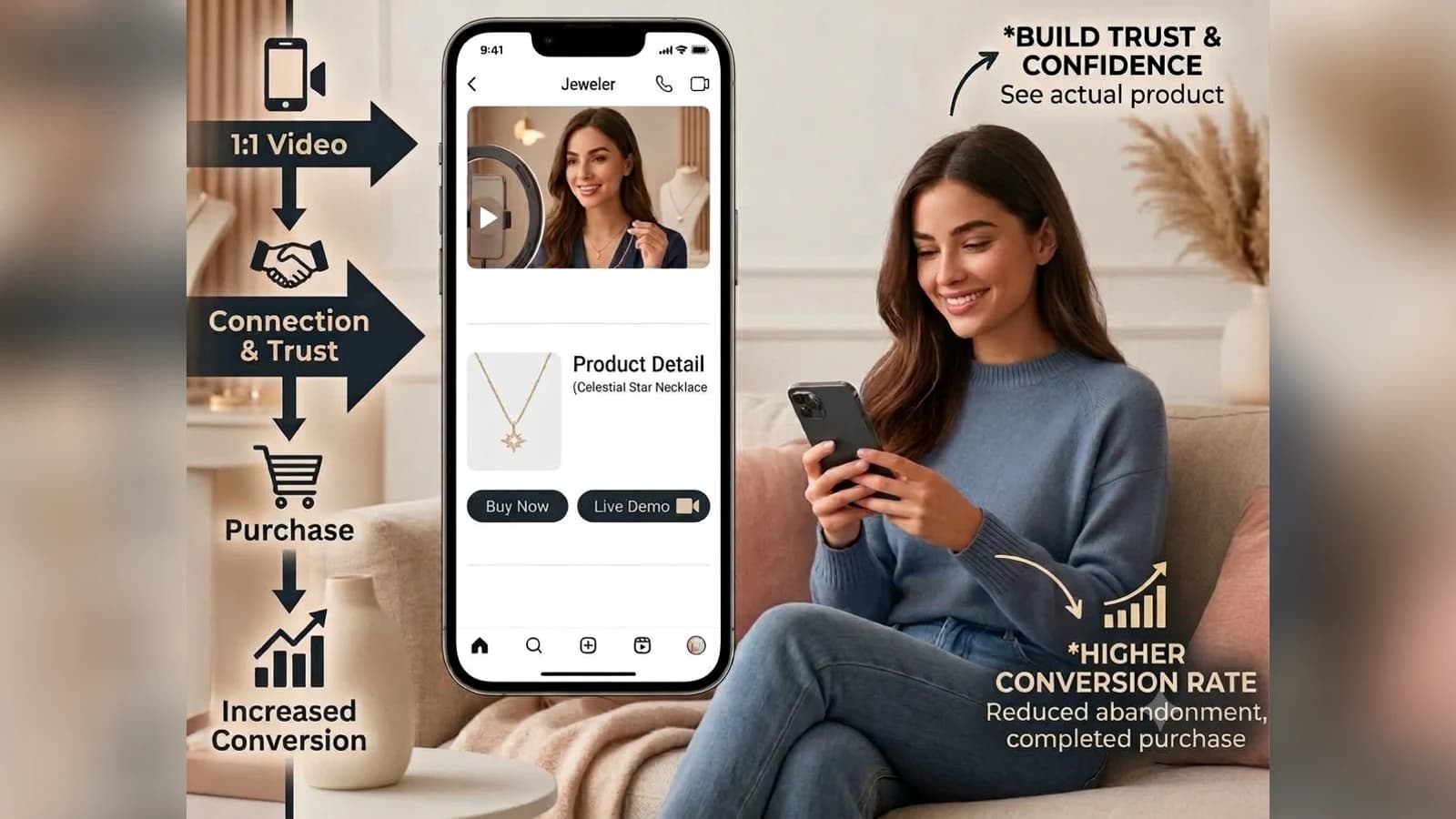
1. Trust arrives at the moment of hesitation
For a purchase at this price, the last thing standing between interest and payment is usually not information. It is confidence. A real conversation with someone from the brand, who can be asked a direct question and give a direct answer, is a different kind of reassurance than another certification badge.
2. Products can be demonstrated rather than described
A sales expert on camera can hold the piece under a light, turn it, put it against a hand, and set it beside the design the shopper was comparing it with. This is the part a product page structurally cannot do, because the shopper's question was not anticipated when the page was built.
3. Recommendations get personal
Rather than leaving someone to filter through a catalogue, a sales expert can ask what the occasion is, what the budget really is, and what they have already ruled out, then show three pieces that fit. Most jewellery shoppers do not want more options. They want the right one identified.
4. High intent becomes visible
A shopper who asks for a video consultation has told the brand something that no analytics event conveys as clearly. They are considering a purchase seriously enough to talk to a person about it. That is among the strongest buying signals a jewellery website ever receives, and on most sites there is nothing in place to receive it.
5. The conversation does not have to end when the call does
Plenty of jewellery purchases are not decided in one sitting. Someone consults a partner, waits for a salary date, or wants to see two more options. If the shopper's details and the context of what they were looking at are captured, that becomes a follow-up with something to say. If they are not, the visit ends and the brand never knows it happened.
Why not just use WhatsApp or Zoom?
This is the first question most jewellery brands ask, and it is a fair one. Many are already sending product videos over WhatsApp and taking calls from serious buyers. That is assisted selling, and it works.
The difference is not the video. It is everything around the video.
- Shopper
- Hunt for a contact
- Message or schedule
- Conversation off-site
- Manual follow-up
- Shopper
- Connect from the page
- Sales expert
- Lead captured
- Follow-up
- Performance tracked
On a general purpose tool, the shopper has to leave the product page, find a way to get in touch and start a conversation somewhere else, at which point the brand has lost both the context of what they were viewing and any record of the interaction. What remains is a chat thread on one person's phone.
Winklook brings the conversation onto the page the shopper is already on, and puts a system around it:
- 1:1 video calling, started from the product page
- Video appointments, for shoppers who would rather book a time
- Routing to the right sales expert
- Lead capture on every conversation
- Shopper context, so the expert knows what is on screen before answering
- Call recording and transcription
- Sales agent performance analytics
- Conversation insights, covering the questions that keep coming up
- CRM integration
- Conversion tracking and revenue attribution
The video call is the visible part. The reason to use a platform rather than a phone is the rest of it.
Turning assisted selling into a channel you can actually see
Here is the problem with assisted selling as most jewellery brands practise it today. A sales associate can spend thirty minutes on WhatsApp walking a shopper through four necklaces and close a significant order, and the ecommerce team will never see it.
Ask the questions a head of ecommerce would reasonably ask, and there is usually no answer:
- How many shoppers received assistance this month?
- Which sales expert handled them?
- How many leads came out of those conversations?
- How many ended in a purchase?
- Which products generate the most questions?
- Which sales experts convert best, and what are they doing differently?
- How much revenue is assisted selling actually contributing?
Without those answers, assisted selling stays an informal activity that some people happen to be good at. It cannot be resourced properly, it cannot be coached, and it is the first line cut when someone reviews the budget, because nobody can put a number next to it.
An online sales channel is not a channel until somebody can report on it.
This is the shift worth aiming at: from an informal sales conversation happening on somebody's phone, to a measurable online sales channel with volume, performance and revenue attached to it.
Which shoppers should be offered a video consultation
Not all of them. A brand that interrupts every visitor with an offer to talk is a worse experience, not a more helpful one, and plenty of jewellery shoppers would genuinely rather decide alone. Assistance that cannot be ignored stops being assistance.
The moments where it earns its place:
- High-value pieces, where the cost of being wrong is real
- Custom, bespoke or personalised jewellery
- Shoppers who are clearly comparing two or three designs
- Shoppers spending a long time on a single product page
- Repeat visitors returning to the same piece
- Anyone who asks a question, in any channel
- Hesitation at checkout
- Shoppers who want to see a piece more closely before committing
Offered at those moments, a video consultation reads as service. Offered indiscriminately, it reads as a pop-up.
The bigger opportunity for jewellery brands
Jewellery ecommerce has been framed for years as a trade-off. Digital convenience and reach on one side, the expertise and trust of the showroom on the other, and brands choosing how much of each to accept.
It does not have to be a trade-off. The website is genuinely good at discovery, browsing, comparison and transacting. Sales experts are genuinely good at the part the website is worst at, which is helping someone decide. There is no reason those have to happen in different places.
Winklook helps jewellery brands turn their website into an assisted selling channel. Sales experts can connect with high-intent shoppers over 1:1 video, answer their questions, show pieces properly, recommend alternatives and capture the opportunities that need following up. At the same time, the brand can track those conversations, monitor how the team is performing, and understand what assisted selling contributes to online sales.
The traffic is already arriving. The expertise already exists inside the business. For most jewellery brands, the gap between the two is the cheapest conversion work available.
Bringing the sales team onto the website
A 0.72% conversion rate is not a verdict on jewellery ecommerce. It is a description of what happens when a considered, emotional, expensive purchase is asked to complete itself without anyone to ask.
Adding a person back into that moment will not fix everything, and it will not suit every shopper. But for the ones who are clearly interested and clearly stuck, it is the difference between a sale and a closed tab. That is worth finding out on your own product pages.