How online jewellery brands can bring the in-store experience online
Your showroom converts because of what happens between walking in and deciding. Almost none of that survives the move to a product page, and most of it does not have to be lost.
Jewellery shopping was never just buying a product
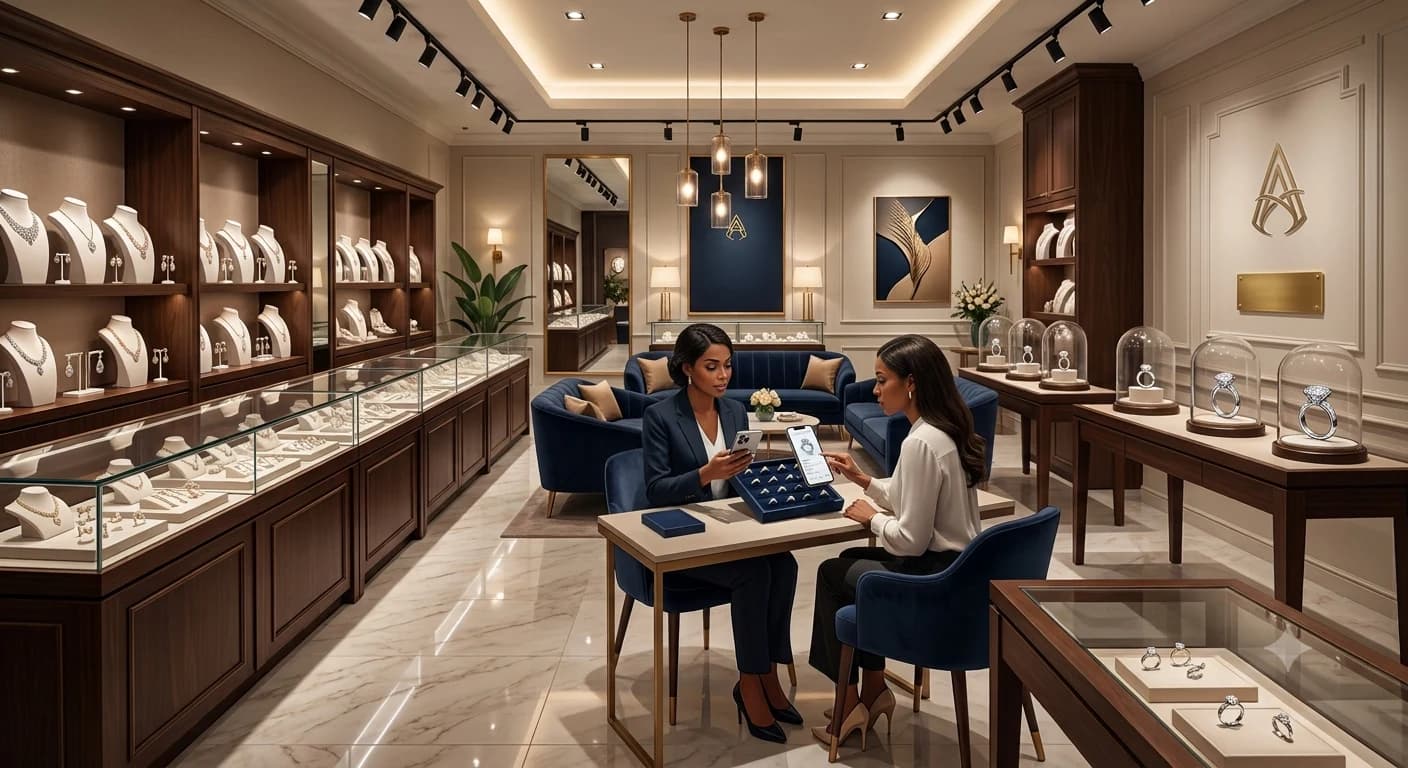
Someone walks into a jewellery showroom and says: I am looking for a diamond ring for an anniversary.
Watch what the person behind the counter does next. They ask who it is for and how long you have been married. They ask, carefully, what you were thinking of spending. They bring out three rings rather than thirty. They put two side by side and tell you the honest difference between them. They notice you keep returning to one and say so. They mention that this setting is easier to resize later, which you did not know to ask about. They tell you it can be ready by Thursday.
Somewhere in those ten minutes the decision got made. Not because the shopper was persuaded, but because they stopped being uncertain.
The salesperson is not the last step of the jewellery buying process. They are most of it.
Every jewellery brand knows this about its stores. It is why the good ones invest heavily in training, why experienced staff are protected, and why a strong salesperson is treated as an asset rather than a cost. The odd part is how little of that thinking survives the move online.
What happens when that experience moves to a website
The online version of the same visit looks like this, and it is worth being fair about how much of it works well.
- Search
- Product page
- Images
- Specifications
- Reviews
- Checkout
That is a genuinely good experience for a shopper who already knows what they want. It is available at midnight, it never runs out of patience, it shows the entire catalogue rather than what happens to be in the case, and it lets someone compare designs without a salesperson watching them do it.
But notice what the anniversary shopper was actually doing in the showroom. They were not gathering information. They were being helped to choose. And the questions that come with choosing do not have a page to live on:
- Which of these is right for me, rather than which is better?
- How does it actually look on a hand, not on a model?
- What is the real difference between these two, in plain language?
- Can you show me something similar closer to my budget?
- Can someone explain these diamond specifications properly?
- What size should I choose if I am not sure of hers?
In a store, all six get asked out loud and answered in a minute. Online, the shopper searches, or sends a message and waits, or opens a competitor in a new tab. The website did not fail. It simply was not built to answer a question nobody could have anticipated.
The website does not have to replace your sales team
There is an assumption buried in most jewellery ecommerce strategy, and it is worth saying out loud so it can be examined: that the website is a substitute for the store, and its job is to reproduce the store's output without the store's people.
That framing sets the website an impossible task. It has to sell a considered, emotional, expensive purchase with no one available to reassure anybody. It is also unnecessary, because the brand already employs the people who are good at this. They are just not reachable from the page where the hesitation happens.
Your website does not have to replace your sales team. It can extend it.
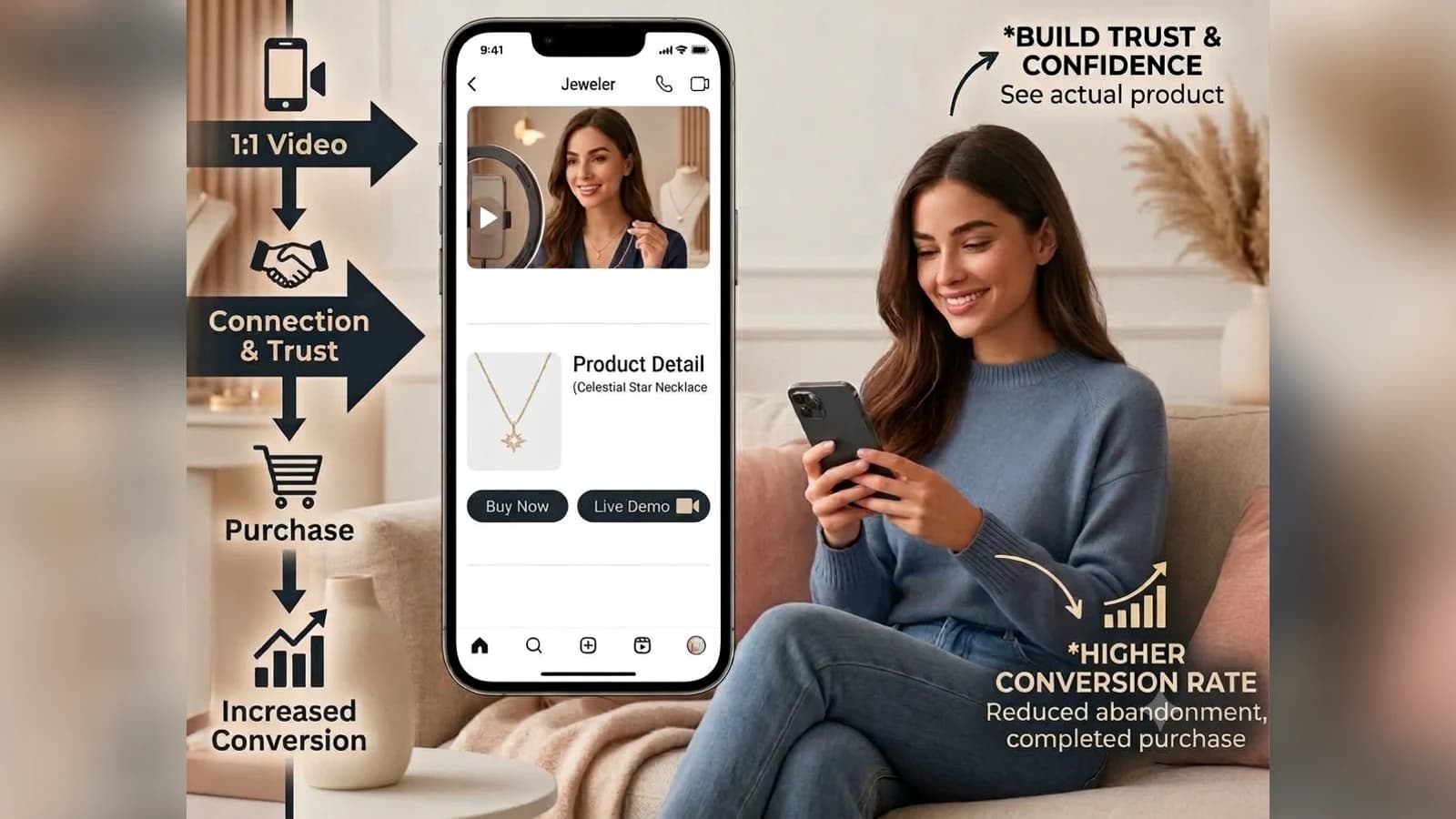
That is the shift this article is arguing for. Not a better product page, and not more automation, but a route from the product page to a person, for the shoppers who want one.
What a 1:1 video consultation brings back
Go back to the six things the showroom salesperson did. Each has a direct equivalent on a video call, and it is worth being concrete about them rather than talking about engagement.
Understanding the shopper before showing anything
The first thing a good salesperson does is ask questions. What the occasion is, whose taste this has to suit, what is actually being spent, what has already been ruled out. None of that can be collected by a product page, and all of it determines what should be shown next.
Showing the piece properly
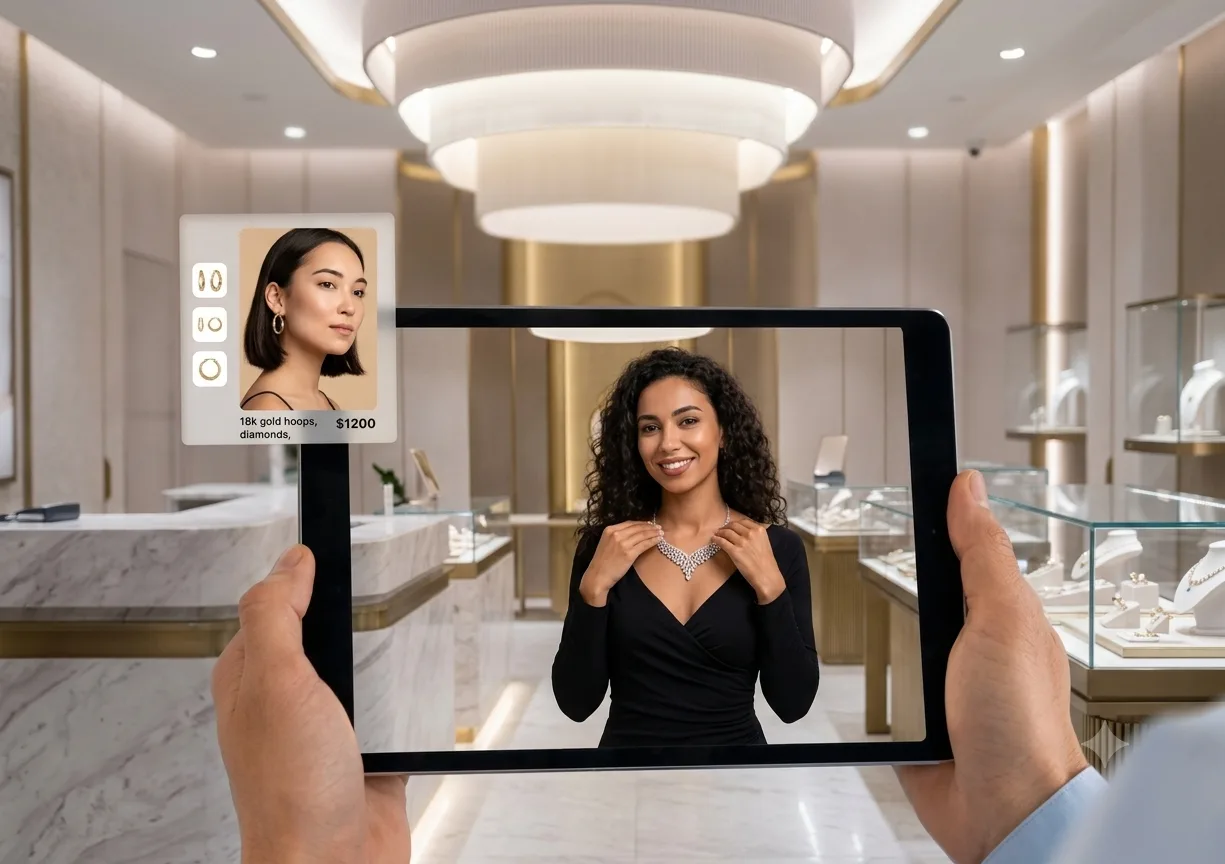
On camera, a sales expert can hold a ring under a light, turn it slowly, show the profile, and put it against a hand for scale. This is the closest online equivalent to lifting something out of the case, and it answers the question photography structurally cannot, which is how a piece behaves rather than how it photographs.
Comparing two pieces in one view
Comparison is where most online jewellery journeys stall. The shopper opens two tabs and switches between them, which is a poor way to judge anything. In a store the two pieces sit next to each other on the counter. On a call they can do the same, with someone explaining what they are looking at.
Recommending something the shopper had not found
A salesperson who understands the brief will often bring out something the shopper never would have clicked on. That is not upselling. It is the value of knowing a catalogue well enough to match it to a person, and it is invisible in a self-service journey.
Building confidence in the brand, not just the product
For a purchase of this size from a brand someone has not bought from before, part of the hesitation is about the brand itself. Talking to a real person who represents it does something no trust badge does.
Carrying the decision to a conclusion
Once the questions are answered, a salesperson does the last and most practical thing: they make the next step obvious. Whether that is completing the purchase, arranging a resize or agreeing to speak again on Sunday, someone is steering.
A conversation is not a sales process
Most jewellery brands reading this are already doing some version of assisted selling. Product videos over WhatsApp, calls with serious buyers, a sales associate who has built a personal following. It works, and nobody should be told otherwise.
The limitation is not the video quality. It is that a conversation is not the same thing as a process.
A process is something a brand can rely on. It happens the same way whoever is working that day. It does not depend on a shopper finding the right number, or on one associate remembering to follow up, or on a thread that lives on a personal phone and leaves with the person who owns it. It can be resourced, staffed, improved and handed over.
What most jewellery brands have today is a set of conversations. What converts reliably at scale is a process.
What Winklook puts around the conversation
Winklook is not a way to make a video call. It is the workflow that turns those calls into something a brand can run.
A shopper connects from the product page they are already on, or books a time that suits them if nobody is free. The request reaches the right sales expert rather than whoever happens to answer, and that expert arrives already knowing which piece is on screen, so the conversation starts at the question instead of at the beginning. The shopper's details and what they were interested in are captured whether or not they buy that day, which means a follow-up has something specific to say. The call can be reviewed afterwards, which is how a team gets better at this rather than just busier.
And every one of those interactions leaves a record, which is what the next section is about.
Not every shopper, and that matters
A showroom does not send someone over the moment a person walks in. Good staff read the room. They give browsers space and they approach the person who has been standing at one case for four minutes looking uncertain.
The online version should behave the same way. An offer of help that cannot be dismissed is not service, it is a pop-up. The moments where it earns its place:
- Someone on a high-value piece, where being wrong is expensive
- Custom or bespoke enquiries, which cannot be self-served at all
- A shopper moving repeatedly between two or three designs
- Unusually long time on a single product page
- A returning visitor coming back to the same piece
- Anyone who asks a question, in any channel
- Hesitation at checkout
Offered at those moments, a video consultation reads as a brand paying attention. Offered to everyone, it reads as desperation.
The shop floor is already visible. The website is not.
Walk into any jewellery store and the sales process is legible. A manager can see who is on the floor, who is with a customer, who closed what, and who needs help. None of that requires a system. It requires standing there.
Online, the same activity is invisible. An associate can spend thirty minutes on WhatsApp walking someone through four necklaces and close a significant order, and nobody outside that chat will ever know it happened. The store's best sales behaviour has moved to a channel where management cannot see it.
That is the real cost of informal assisted selling, and it is not the conversations themselves. It is that the brand cannot tell how many shoppers are being helped, who is good at it, which pieces generate the most questions, or what any of it contributes. So it cannot be staffed properly, it cannot be coached, and at budget time it is the line nobody can defend.
Giving those conversations a structure gives them a number. That is what turns online assisted selling from something a few people happen to be good at into a channel the business can actually manage.
Online convenience plus in-store expertise
Jewellery ecommerce has spent a decade framed as a contest. Online against offline, digital against retail, convenience against expertise, with brands deciding how much of each to accept.
The framing is wrong, because the two are good at different halves of the same purchase. The website handles discovery, browsing, information and transacting, at any hour, for anyone, anywhere. The sales team handles guidance, comparison, recommendation and confidence. There is no reason a shopper should have to leave one to get the other.
- Website traffic
- High-intent shopper
- 1:1 assistance
- Guidance
- Confidence
- Purchase or follow-up
Winklook helps jewellery brands extend their sales experience beyond the showroom floor. Sales experts can reach high-intent shoppers over 1:1 video, understand what they are actually trying to buy, show pieces properly, suggest alternatives and carry the decision to a conclusion. Around that, the brand captures the leads, manages the interactions and can finally see what assisted selling is contributing online.
The people who are good at this already work for you
This is not a case for hiring, or for new technology for its own sake. The expertise that closes jewellery sales already exists inside the business. It is standing on a shop floor, reachable by anyone who drives to the store and by nobody who visits the website.
The traffic is already arriving. The people who could convert it are already employed. For most jewellery brands, connecting those two things is the least expensive sales improvement available, and it is worth seeing on your own product pages before deciding.